
Your choice of a rubber molding process effects part performance, tooling costs, production efficiency, and long-term reliability. The molding method you select also effects dimensional consistency, flash control, cycle time, scalability, and total cost of ownership.
For engineers and product designers, choosing compression, transfer, or injection molding isn’t just about manufacturing. It’s about meeting application requirements across the entire product lifecycle. The Rubber Group offers all three molding services and can help you make the right choice.
How to Make the Right Choice
At The Rubber Group, we work closely with engineering teams to evaluate geometry, material behavior, regulatory requirements, and production goals before recommending a molding strategy. Our decades of experience in compression, transfer, and injection molding mean that we help customers select the most effective and cost-efficient method early in their development process. This reduces risk and helps avoids costly redesigns.
When balancing tooling costs against precision and speed, many designers focus on injection molding vs. compression molding; however, transfer molding plays a critical middle role. Specifically, it offers improved dimensional control and insert-molding capability without the larger investment of injection tooling. Understanding how compression, injection, and transfer molding compare allows teams to align manufacturing strategy with performance and production objectives.
Comparing Rubber Molding Methods
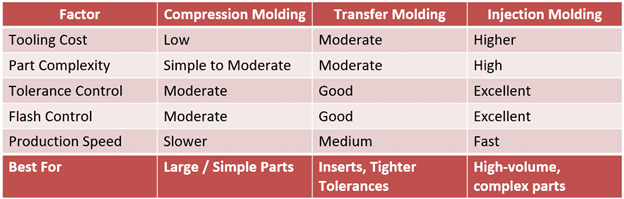
This guide compares compression, transfer, and injection molding in terms of capability, complexity handling, and scalability so that you can make an informed decision. Use the table below for an overview. Then see the sections that follow for more information. To request a quote or discuss your molding application, contact The Rubber Group.
Compression Molding
Compression molding is a cost-effective and commonly used process. A pre-measured amount of an elastomer is placed into an open, heated mold cavity, which then closes under heat and pressure to cure the material. Because the rubber flows under compression rather than injection, the tooling costs are typically lower. This makes compression molding well-suited for low-to-medium-volumes.
Often, compression molding is used with large, thick, or relatively simple parts with moderate tolerances. It handles high-durometer materials well and produces less waste than transfer molding. Yet compression molding can result in more flash and longer cycle times than injection molding. This makes it less suitable for highly intricate geometries or automated high-volume production.
Transfer Molding
Transfer molding bridges the gap between compression and injection molding. A rubber material is placed in a chamber, and a plunger forces it through runners into closed mold cavities. Compared to compression molding, the controlled flow of transfer molding improves dimensional consistency and cavity fill.
Transfer molding is used with inserts because the closed cavity supports alignment and bond integrity during curing. It also supports tighter tolerances and improved surface finish. Tooling costs and material waste are higher than with compression molding, but transfer molding supports moderate complexity and improved precision without the higher tooling costs of injection molding.
Injection Molding
Injection molding is the most automated and controlled of the three molding processes. An elastomeric material is heated and plasticized before being injected under pressure into a closed mold cavity. This enables precise control of material flow, temperature, and pressure with results that include excellent repeatability and dimensional accuracy.
Injection molding is best suited for complex geometries, thin walls, tight tolerances, and high-volume production. It minimizes flash, reduces cycle times, and supports scalable manufacturing. Although the tooling investment is higher, injection molding provides strong long-term value when precision, consistency, and efficiency are critical.
Understanding Key Differences
What’s the main difference between injection and compression molding? It’s about precision and scalability.
- Compression molding is preferred for simpler parts and a lower tooling investment, especially when tolerances are moderate and volumes are manageable.
- Injection molding is recommended when tighter control, faster cycles, and production scalability are essential.
With injection molding, the upfront tooling investment is greater; however, this molding method often provides stronger lifecycle value for complex or high-volume applications.
What about transfer molding? It remains a practical middle-ground solution when insert molding or improved tolerances are required without a full commitment to injection tooling.
Ask The Rubber Group for Help with Process Selection
There is no universal “best” molding process. Each offers distinct advantages depending on part geometry, tolerance requirements, regulatory considerations, and expected production volume. Ultimately, it’s important to select the method that best supports your design, material, and production objectives.
At The Rubber Group, selecting the right molding process isn’t a transactional step. Instead, it’s a collaborative engineering exercise. Our team evaluates material performance, tooling strategy, validation requirements, and long-term scalability to ensure your chosen process aligns with both technical performance targets and business objectives.
Thoughtful process selection early in development reduces risk, improves manufacturability, and drives long-term program success. Whether you’re evaluating a new rubber component or reconsidering an existing design, contact The Rubber Group to review your application. We’ll help you determine the most effective molding strategy for performance, cost, and long-term reliability.